1. Overview
Oxidative stress is a central concept in modern molecular and cellular biology, describing a disruption in redox homeostasis caused by an imbalance between the generation of reactive species and the capacity of antioxidant systems. Contemporary definitions extend beyond the classical “oxidative damage” model and recognize reactive oxygen species (ROS), reactive nitrogen species (RNS), and reactive sulfur species (RSS) as integral components of cellular physiology.
In biological systems, redox balance is not static but dynamically regulated. Cells operate under a finely tuned equilibrium in which reactive species function as signaling intermediates at low to moderate concentrations, while excessive accumulation leads to macromolecular damage and functional disruption. This dual role has led to the conceptual refinement of oxidative stress into oxidative eustress (physiological signaling) and oxidative distress (pathological overload).
2. Cellular Sources and Spatial Organization of Reactive Species
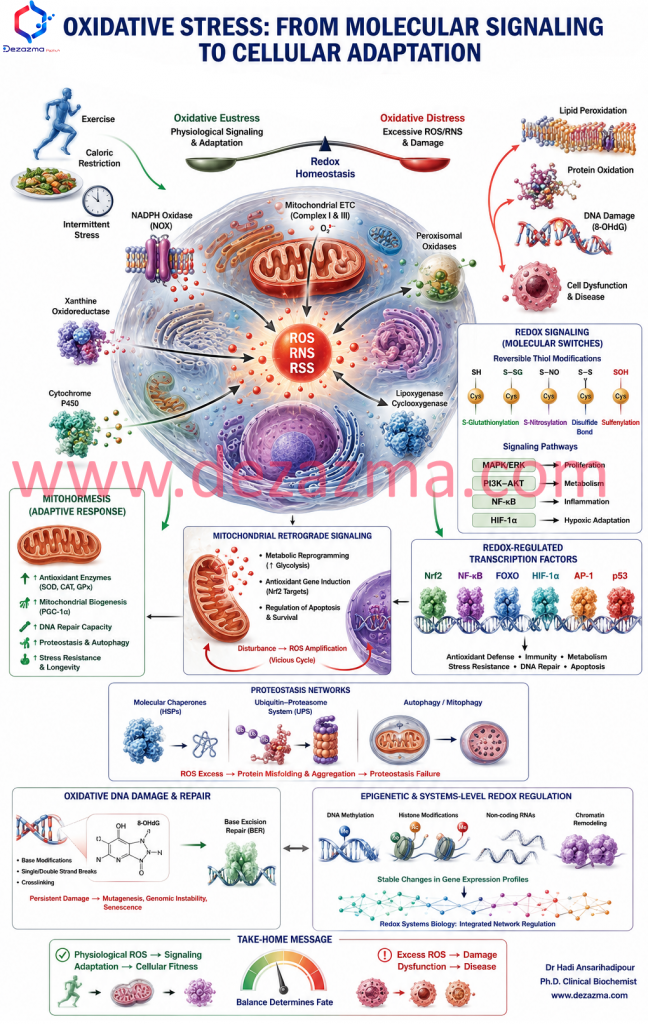
Reactive species are generated through multiple enzymatic and non-enzymatic processes distributed across cellular compartments. The most prominent intracellular source is the mitochondrial electron transport chain (ETC), particularly Complex I and Complex III, where electron leakage to molecular oxygen produces superoxide (O₂•⁻).
However, mitochondria represent only one node in a broader redox network. Additional enzymatic sources include:
• NADPH oxidase (NOX) complexes, which deliberately generate ROS for signaling and immune defense
• Xanthine oxidoreductase, involved in purine metabolism
• Cytochrome P450 enzymes, participating in xenobiotic metabolism
• Peroxisomal oxidases, contributing to fatty acid oxidation
• Lipoxygenases and cyclooxygenases, involved in lipid mediator synthesis
Importantly, ROS production is spatially compartmentalized. Distinct subcellular microenvironments (mitochondria, endoplasmic reticulum, nucleus, and plasma membrane) generate localized redox signals. This spatial restriction ensures specificity in redox signaling and prevents uncontrolled diffusion of reactive species.
3. Redox Signaling and Molecular Switching Mechanisms
Contrary to earlier assumptions, reactive species are not merely toxic byproducts but act as second messengers in intracellular signaling pathways. Among them, hydrogen peroxide (H₂O₂) plays a dominant role due to its relative stability and ability to diffuse across membranes via aquaporins.
Redox signaling operates primarily through reversible oxidation of cysteine residues in target proteins. These thiol-based modifications function as molecular switches regulating protein activity. Key reversible modifications include:
• S-glutathionylation
• S-nitrosylation
• Disulfide bond formation
• Sulfenylation (–SOH formation)
These modifications regulate signaling cascades such as:
• MAPK/ERK pathways (cell proliferation)
• PI3K–AKT signaling (metabolic regulation)
• NF-κB activation (immune and inflammatory responses)
• HIF-1α stabilization (hypoxic adaptation)
Thus, redox signaling integrates environmental cues into cellular decision-making processes.
4. Mitohormesis and Adaptive Stress Responses
A key concept in modern redox biology is hormesis, particularly mitohormesis, where low levels of mitochondrial ROS induce adaptive stress resistance. Instead of causing damage, mild oxidative stress activates protective pathways that enhance cellular fitness.
Mitohormetic responses include:
• Upregulation of antioxidant enzymes (SOD, CAT, GPx)
• Activation of mitochondrial biogenesis (via PGC-1α)
• Enhanced DNA repair capacity
• Improved proteostasis and autophagy
This adaptive framework explains why physiological stressors such as exercise, caloric restriction, and intermittent metabolic stress can enhance cellular resilience and extend functional lifespan.
5. Mitochondria as Signaling Hubs and Retrograde Communication Centers
Mitochondria occupy a dual role as both major sources and sensitive targets of oxidative stress. Beyond ATP production, mitochondria function as signaling organelles that communicate their functional state to the nucleus through mitochondrial retrograde signaling.
When mitochondrial function is altered, ROS act as signaling mediators that modify nuclear gene expression. This leads to metabolic reprogramming, including:
• Shift toward glycolytic metabolism under stress
• Induction of antioxidant gene networks
• Regulation of apoptosis and survival pathways
Mitochondrial dysfunction also amplifies ROS production, creating a self-reinforcing loop of oxidative amplification known as the “vicious cycle” of mitochondrial oxidative injury.
6. Oxidative Stress and Proteostasis Networks
Cellular protein homeostasis (proteostasis) is tightly regulated by redox mechanisms. Oxidative modifications influence protein folding, stability, and degradation.
Major proteostatic systems affected by ROS include:
• Molecular chaperones (heat shock proteins)
• Ubiquitin–proteasome system (UPS)
• Autophagy and selective mitophagy
Oxidative damage can lead to protein misfolding, aggregation, and loss of function. However, moderate ROS levels also activate proteostatic pathways, indicating a regulatory rather than purely destructive role.
Failure of proteostasis is a key feature of aging and neurodegenerative processes.
7. Redox Regulation of Transcriptional Networks
Gene expression is extensively controlled by redox-sensitive transcription factors. These include:
• Nrf2 (Nuclear factor erythroid 2–related factor 2): master regulator of antioxidant response
• NF-κB: immune and inflammatory signaling
• FOXO proteins: stress resistance and longevity regulation
• HIF-1α: hypoxic adaptation
• AP-1: proliferation and differentiation
• p53: DNA damage response and apoptosis
Nrf2 is particularly important because it coordinates the expression of detoxifying enzymes, glutathione metabolism genes, and cytoprotective proteins. Under oxidative stress, Nrf2 translocates to the nucleus and activates antioxidant response elements (AREs), establishing a broad defensive transcriptional program.
8. Oxidative DNA Damage and Genome Stability
Reactive species interact directly with nucleic acids, producing oxidative lesions such as base modifications, strand breaks, and crosslinking. A widely recognized marker of oxidative DNA damage is 8-hydroxy-2′-deoxyguanosine (8-OHdG).
Persistent oxidative DNA damage contributes to:
• Mutagenesis
• Genomic instability
• Altered gene expression
• Cellular senescence
DNA repair pathways, including base excision repair (BER), are essential for maintaining genomic integrity under oxidative conditions.
9. Epigenetic and Systems-Level Redox Regulation
Beyond direct molecular damage, oxidative stress influences epigenetic regulation, including:
• DNA methylation patterns
• Histone modifications
• Chromatin remodeling
• Non-coding RNA expression
These changes produce long-term alterations in gene expression profiles, linking environmental stress exposure to stable cellular phenotypes.
At the systems level, redox biology operates as an integrated network in which metabolism, signaling, gene regulation, and organelle function are interconnected. This perspective has led to the development of redox systems biology, which views oxidative stress as a network property rather than a single molecular event.
10. Conclusion: Oxidative Stress as a Biological Regulatory Principle
Oxidative stress is no longer understood as a purely pathological condition but as a fundamental regulatory principle in biology. Reactive species serve as essential mediators of cellular signaling, metabolic adaptation, and environmental responsiveness. Cellular outcomes depend on the intensity, duration, and spatial distribution of redox signals.
At physiological levels, redox signaling supports homeostasis, adaptation, and survival. At excessive levels, oxidative distress disrupts biomolecular integrity and cellular function. The balance between these states is maintained through complex antioxidant systems, transcriptional regulators such as Nrf2, and adaptive mechanisms including mitohormesis and proteostasis networks.
Understanding oxidative stress as an integrated redox signaling system provides a unified framework linking molecular biology, cell physiology, and systems-level adaptation in living organisms.
Core Concepts of the Article
1. Oxidative Stress
Central conceptual hub of redox biology and cellular regulation.
2. Reactive Oxygen Species (ROS) in Cells
Core molecular basis of redox biology; very high academic search volume.
3. Antioxidant Systems in Cells
Enzymatic and non-enzymatic defense mechanisms in cellular biology.
4. Mitochondrial ROS and Bioenergetics
Links respiration, electron transport chain, and redox signaling.
5. Redox Signaling and Cellular Communication
Focus on signaling networks rather than pathology.
6. Redox Homeostasis in Biological Systems
Systems biology perspective of balance and regulation.
7. Compartmentalized ROS Production
Advanced concept: spatial redox biology (mitochondria, ER, peroxisomes, membrane).
8. Thiol-Based Redox Regulation (Cysteine Biology)
Protein-level redox switching and molecular regulation.
9. Oxidative Stress and Cellular Adaptation
Includes hormesis, stress responses, and environmental adaptation.
10. Oxidative DNA Damage and Repair Mechanisms
Focus on molecular biology (mutation, repair systems, genome stability) without clinical framing.