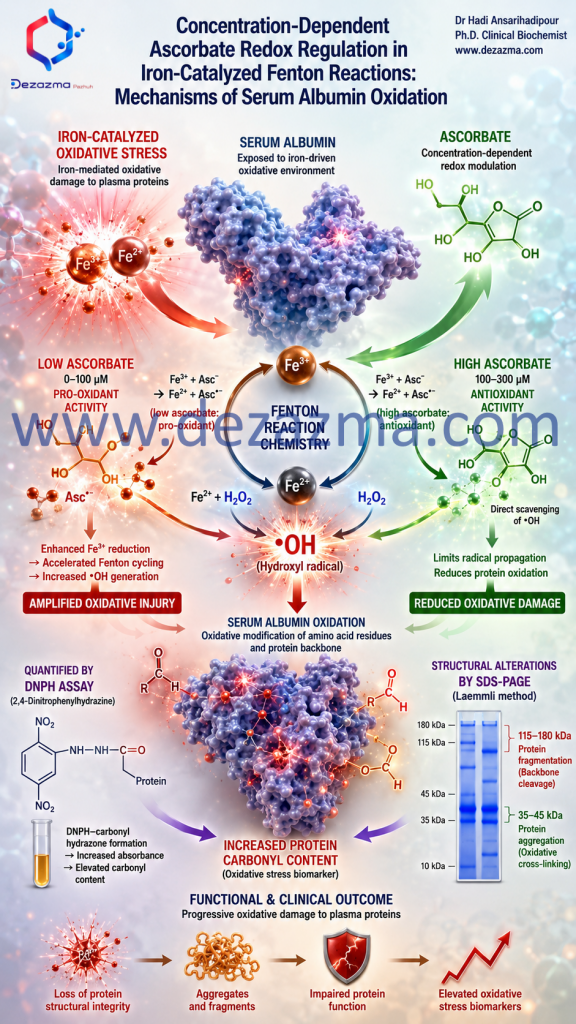
In a metal-catalyzed oxidative system, iron effects is driven by continuous Fenton reaction, in which cycling of the Fe2+/Fe3+ redox pair sustains the generation of reactive oxygen species, predominantly hydroxyl radicals, resulting in progressive oxidative damage to plasma proteins. Within this system, ascorbate redox modulation acts as a concentration-dependent regulator of iron redox cycling and radical production, demonstrating pro-oxidant activity at low concentrations (0–100 µM) and antioxidant activity at higher concentrations (100–300 µM), thereby determining the net direction of oxidative protein modification. Serum albumin exposed to this oxidative environment exhibits significant serum albumin oxidation, reflected by increased protein carbonyl content, quantified using the 2,4-dinitrophenylhydrazine (DNPH) assay, a validated indicator of oxidative stress biomarkers. Structural protein alterations assessed by SDS-PAGE electrophoresis (Laemmli method) reveal marked changes in molecular integrity, including protein aggregation within the 35–45 kDa region and protein fragmentation within the 115–180 kDa range, indicating simultaneous oxidative cross-linking and backbone cleavage. Mechanistically, at low ascorbate concentrations, enhanced reduction of Fe3+ to Fe2+ accelerates Fenton cycling and increases hydroxyl radical formation, amplifying oxidative injury; at higher concentrations, ascorbate functions primarily as a radical scavenger, limiting chain propagation and reducing protein oxidation. This behavior defines a clear dose-dependent redox switch that governs whether ascorbate amplifies or suppresses iron-driven oxidative reactions. Collectively, the interaction between Fenton chemistry, iron redox cycling, ascorbate electron transfer dynamics, and albumin structural susceptibility determines the extent of protein carbonylation and electrophoretic degradation under iron-induced oxidative stress conditions.
Reference:
Ansarihadipour H, Alhoseini M., Rostami S., Farahani N., Hashemi M. Antioxidant and prooxidant effects of ascorbate during iron induced carbonyl formation in serum albumin. Arak Medical University Journal. 2012; 15(61): 17-26.