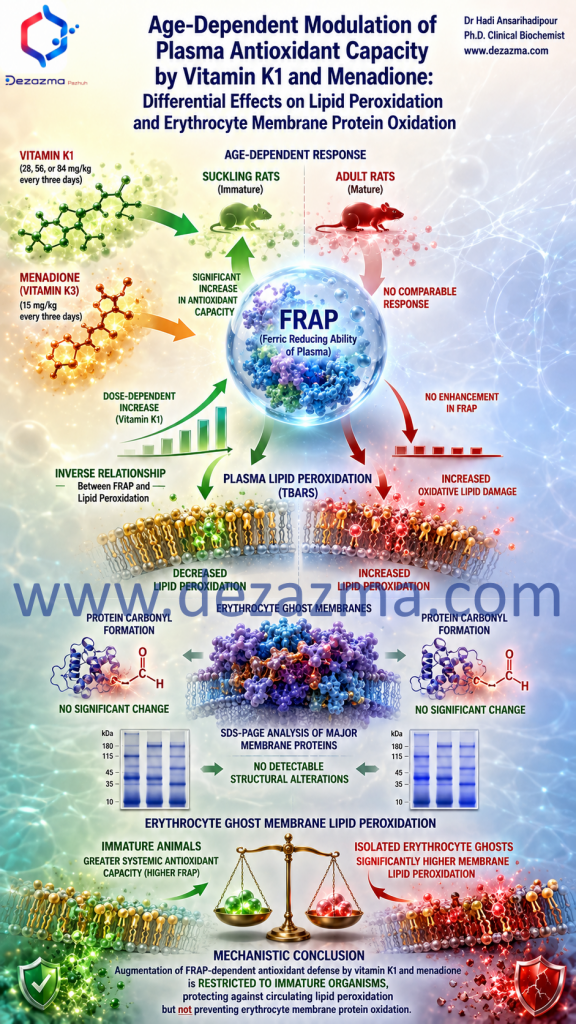
Maintenance of systemic redox homeostasis depends on the balance between antioxidant defense and oxidative injury, making plasma total antioxidant capacity a critical determinant of susceptibility to oxidative stress. Quantification of the ferric reducing ability of plasma (FRAP) demonstrated a significant increase in antioxidant capacity in suckling rats following administration of vitamin K1 (28, 56, or 84 mg/kg every three days) or menadione (vitamin K3) (15 mg/kg every three days), whereas no comparable response occurred in adult animals, indicating a pronounced age-dependent antioxidant response. The elevation in FRAP activity induced by vitamin K1 occurred in a dose-dependent manner and exhibited a significant inverse relationship with plasma lipid peroxidation, measured as thiobarbituric acid reactive substances (TBARS), supporting a protective role against lipid oxidative damage during early postnatal development. Conversely, the absence of FRAP enhancement in adult rats coincided with increased oxidative lipid damage, suggesting diminished adaptive antioxidant regulation with maturation. Evaluation of erythrocyte ghost membranes further demonstrated that neither vitamin K1 nor menadione significantly altered protein carbonyl formation, indicating preservation of erythrocyte membrane protein integrity despite systemic oxidative changes. Consistent with these biochemical findings, SDS-PAGE analysis of major membrane proteins revealed no detectable structural alterations, confirming the absence of significant oxidative protein modification within erythrocyte membranes. Interestingly, although immature animals exhibited greater systemic antioxidant capacity, isolated erythrocyte ghosts simultaneously displayed significantly higher membrane lipid peroxidation, emphasizing that enhanced plasma antioxidant potential does not necessarily confer complete protection against localized membrane oxidation. These findings identify developmental stage as a major determinant of vitamin K-mediated antioxidant regulation, demonstrating that augmentation of FRAP-dependent antioxidant defense is restricted to immature organisms and likely represents an adaptive response limiting the accumulation of circulating lipid peroxidation products rather than preventing erythrocyte protein oxidation. Collectively, the data establish a mechanistic link between vitamin K antioxidant activity, developmental redox biology, plasma antioxidant defense, and the differential regulation of lipid and protein oxidation, providing important insights into age-specific responses to oxidative stress with potential relevance to pediatric oxidative disorders, antioxidant pharmacology, and translational redox medicine.
Reference:
Ansari hadipour Hadi , Allameh Abdolamir, Hajhidari Mahtab, Dadkhah Abolfazl and Rasmi Yusef. Influence of plasma total antioxidant ability on lipid and protein oxidation products in plasma and erythrocyte ghost obtained from developing and adult rats pretreated with two vitamin K formulations. Molecular and Cellular Biochemistry. 2004;267(1-2):195-201.