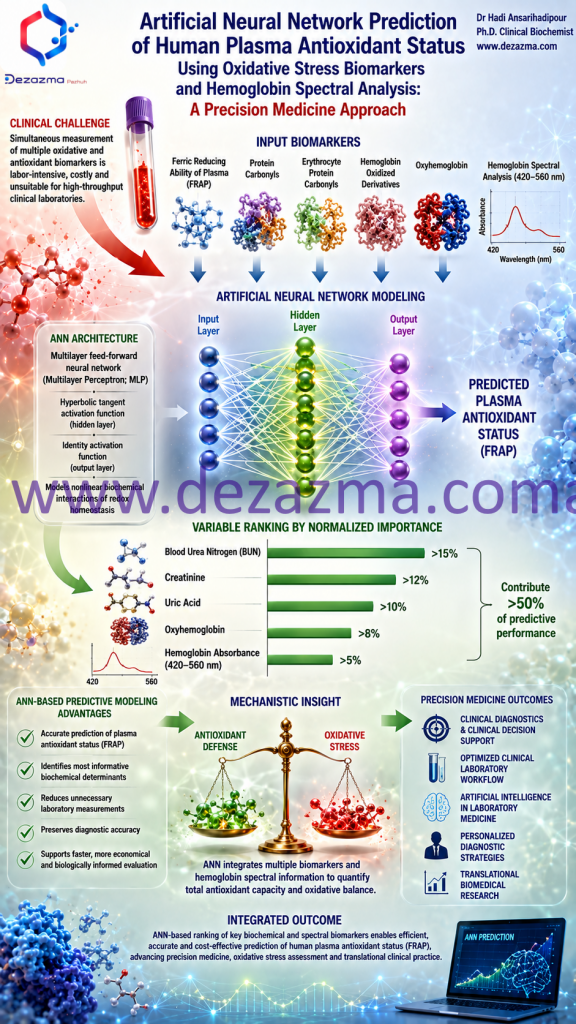
Accurate evaluation of predicting the antioxidant status of human plasma by artificial neural network analysis represents an important advancement in clinical biochemistry, oxidative stress assessment, and precision medicine, particularly because simultaneous measurement of multiple oxidative and antioxidant biomarkers is labor-intensive, costly, and unsuitable for high-throughput clinical laboratories. To establish a reliable computational strategy, blood samples exhibiting normal hematological and biochemical characteristics were analyzed using artificial neural network (ANN) modeling to identify the most informative biochemical determinants of human plasma antioxidant status. Ferric reducing ability of plasma (FRAP) served as the principal indicator of total antioxidant capacity, whereas protein carbonyls, erythrocyte protein carbonyls, hemoglobin oxidized derivatives, oxyhemoglobin, and hemoglobin spectral analysis across the 420–560 nm absorbance spectrum represented complementary biomarkers of oxidative damage and hemoglobin integrity. Prediction was achieved using a multilayer feed-forward neural network based on the multilayer perceptron (MLP) algorithm with hyperbolic tangent activation function in the hidden layer and identity activation function in the output layer, enabling accurate modeling of nonlinear biochemical interactions associated with redox homeostasis. Variable ranking according to normalized importance demonstrated that blood urea nitrogen (BUN), creatinine, uric acid, oxyhemoglobin, and hemoglobin absorbance between 420 and 560 nm contributed more than 50% of the predictive performance, identifying these variables as the dominant determinants of plasma antioxidant capacity. The findings emphasize the value of machine learning in clinical diagnostics, biochemical biomarker prediction, oxidative stress biomarkers, clinical decision support, computational biochemistry, hematological biomarkers, blood antioxidant biomarkers, erythrocyte oxidative damage, protein oxidation, clinical laboratory optimization, predictive biomarker modeling, artificial intelligence in laboratory medicine, nonlinear predictive modeling, biomedical data analysis, clinical biomarker prioritization, and personalized diagnostic strategies, demonstrating that ANN-based ranking can substantially reduce unnecessary laboratory measurements while preserving diagnostic accuracy, thereby supporting faster, more economical, and biologically informed evaluation of antioxidant defense and oxidative balance in routine clinical practice and translational biomedical research.
Reference:
Ansarihadipour, Hadi; Ansarhadipour Mehdi & Ansarihadipour Golnaz. Predicting the antioxidant status of human plasma by artificial neural network analysis.The 20th Annual Congress and the 3rd International Congress of Pathology and Laboratory Medicine & the 7th Meeting of Iranian Division of International Academy of Pathology (IAP). Tehran, Iran. 5-7 December 2018.