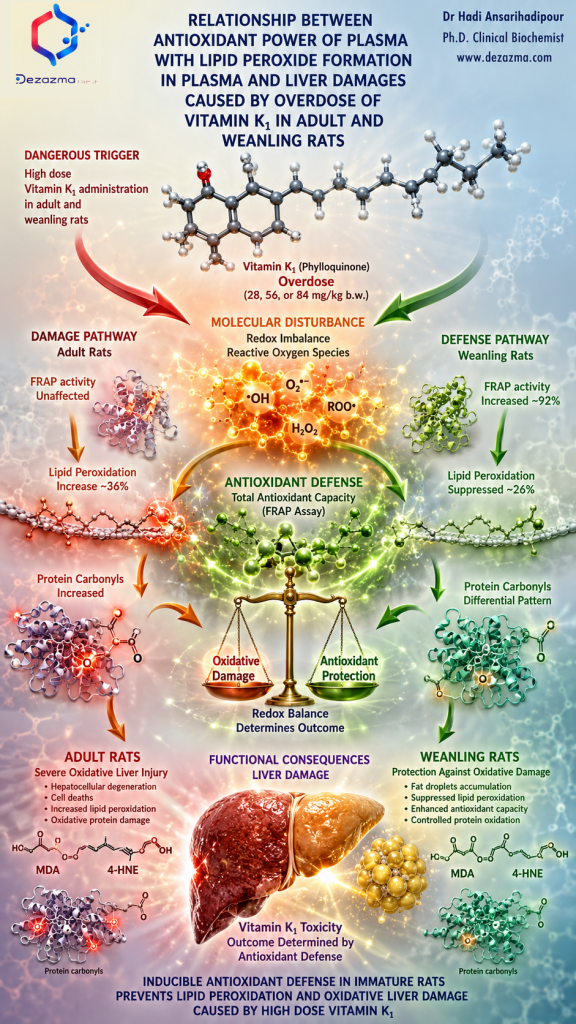
Administration of excessive Vitamin K1 (phylloquinone) produced a pronounced age-dependent oxidative stress response characterized by distinct alterations in plasma antioxidant capacity, lipid peroxidation, and liver injury biomarkers in adult and weanling rats. Quantification of ferric reducing ability of plasma (FRAP) demonstrated that total antioxidant capacity remained unchanged in adult animals despite escalating vitamin K1 doses of 28, 56, and 84 mg/kg body weight, whereas immature animals exhibited a remarkable 92% elevation in FRAP assay values, indicating activation of systemic antioxidant defense mechanisms. Correspondingly, enhanced antioxidant potential in weanling rats was associated with approximately 26% suppression of plasma lipid peroxidation, while adult animals experienced nearly 36% elevation in lipid peroxide formation, demonstrating greater susceptibility to reactive oxygen species-mediated oxidative injury. Assessment of protein carbonyl content, a sensitive marker of oxidative protein damage, revealed a response pattern independent of FRAP alterations, suggesting that protein oxidation biomarkers and antioxidant capacity reflect complementary but mechanistically distinct components of redox homeostasis. Histopathological evaluation of hepatic tissue following administration of 56 mg/kg vitamin K1 further substantiated these biochemical findings by demonstrating accumulation of intracellular lipid droplets in hepatocytes of immature rats, whereas adult livers exhibited extensive hepatocellular degeneration and cell death consistent with severe oxidative liver injury. These observations establish a mechanistic association between antioxidant defense mechanisms, oxidative stress biomarkers, hepatic lipid peroxidation, and differential age-related susceptibility to vitamin K toxicity. The preservation of redox balance in immature animals suggests induction of protective antioxidant pathways capable of limiting oxidative membrane damage and maintaining cellular integrity despite pharmacological vitamin K exposure. Integration of clinical biochemistry, redox biology, oxidative stress assessment, FRAP assay, protein carbonyl analysis, liver histopathology, translational toxicology, free radical biology, hepatic oxidative damage, biomarker profiling, precision laboratory medicine, antioxidant power of plasma, oxidative injury mechanisms, phylloquinone toxicity, age-dependent antioxidant response, plasma oxidative biomarkers, liver pathology, cellular antioxidant systems, redox signaling, and experimental hepatotoxicity provides a comprehensive framework for understanding how developmental stage determines susceptibility to vitamin K1-induced oxidative damage and supports the application of blood-based biomarkers for mechanistic toxicological evaluation and translational risk assessment.
Reference:
Ansarihadipour H, Allameh A and Kazemnejad A. Relationship between antioxidant power of plasma with lipid peroxide formation in plasma and liver damages caused by overdose of vitamin K1 in adult and weanling rats. Acta Medica Iranica. 2003;41(4):207-213.